
AI has quietly become part of everyday life. We ask it to summarize emails, explain homework, generate images, and even help us write. Along the way, a whole new vocabulary came with it, words like LLM, token, context window, fine-tuning, and hallucination. If those words have ever made you feel like everyone else received a glossary except you, settle in. Most of them are simply labels for ideas that are much simpler than they sound, and today we are going to unpack them together, one cup of tea at a time.
🪴 Before we begin, where does an LLM fit?
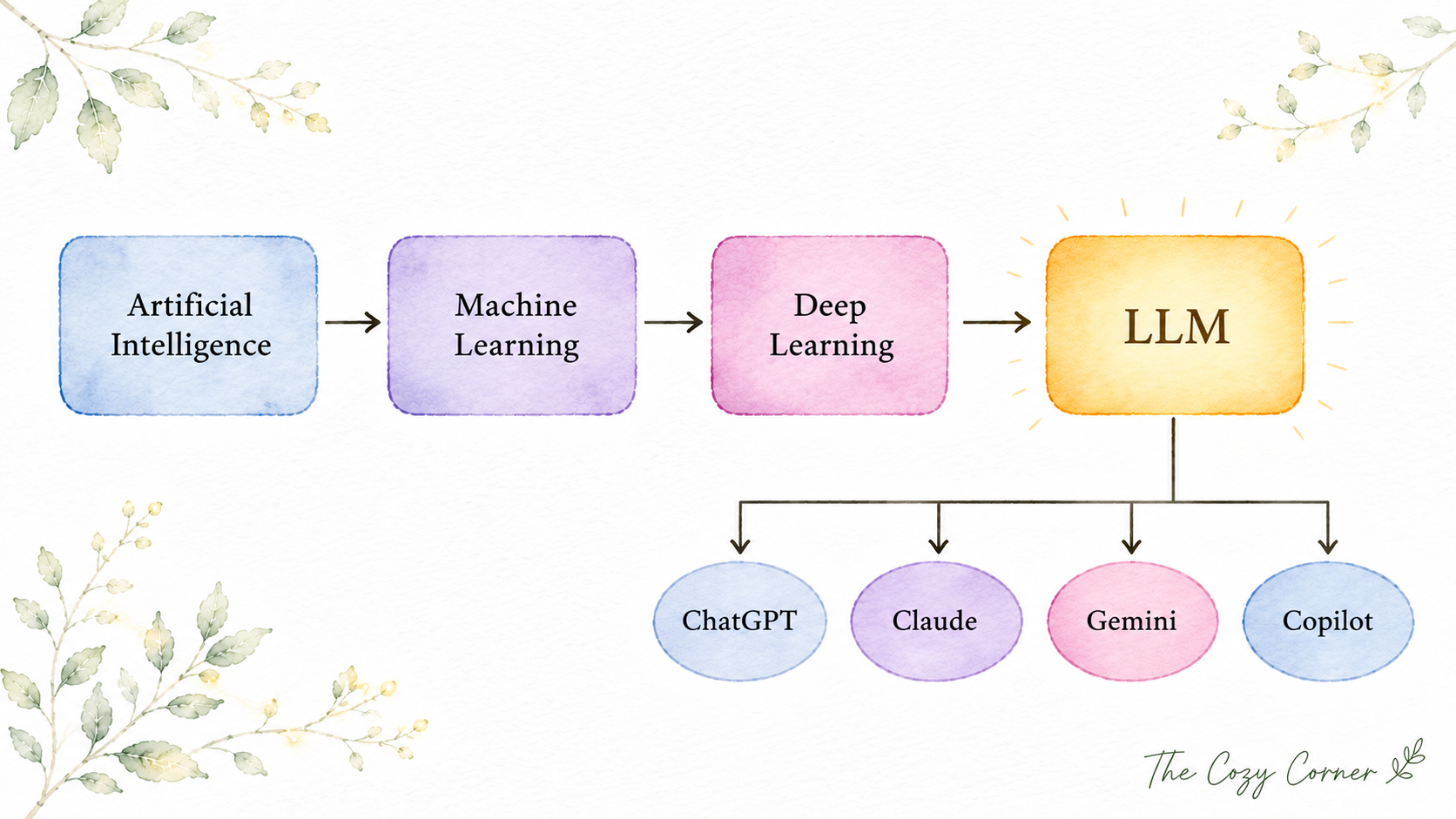
One thing that confused me when I first started learning about AI was where an LLM actually fits into the bigger picture. Here is the simplest way to think about it.
Artificial Intelligence is the broad field, the big umbrella that covers any machine trying to act smart. Machine Learning is one way of building AI, where a computer improves at a task by learning from examples instead of following fixed rules. Deep Learning is a powerful branch of machine learning that uses many layers of learning at once, loosely inspired by how the brain works. Large Language Models, or LLMs, sit inside that branch, specializing in one thing: understanding and generating language. Familiar tools like ChatGPT, Claude, Gemini, and Copilot are simply applications built on top of these language models.
Now that we know where they fit, let us look at what they actually are.
🕯️ What exactly is an LLM?
LLM stands for Large Language Model. At its heart, an LLM is a computer program trained to do one simple thing extremely well: predict what word is likely to come next. That sounds almost too simple to explain something capable of writing essays, answering questions, translating languages, or explaining quantum physics. The secret is not cleverness, it is scale.
Imagine reading millions of books, articles, websites, recipes, and conversations, not to memorize every sentence, but to notice patterns. Which words tend to appear together. How stories usually begin. How people explain difficult ideas. How a joke builds toward its punchline. Do that enough times, and those patterns start to feel like understanding, even though nothing is technically being memorized.
An LLM does not think like a human, and it does not truly understand language the way we do. What it has become remarkably good at is recognizing patterns and using them to produce responses that feel natural and helpful.
📜 How does it learn all this?
The learning happens during a stage called training. The model is shown enormous amounts of text and is repeatedly asked to guess what comes next. Every guess is checked against the real answer, and when it is wrong, a tiny correction is made inside the model. Then it tries again. This happens billions, even trillions, of times, and little by little, the model gets better at grammar, style, facts, and the many subtle patterns that make language work.
Those tiny adjustable pieces inside the model are called parameters. Hearing that a model has billions of parameters does not mean it has billions of facts memorized. Think of parameters more like billions of tiny dials, each one nudged slightly during training until the whole system gets better at recognizing patterns.
🧵 Tokens, the building blocks
Before an LLM can read a message, it first breaks the text into smaller pieces called tokens. A token might be a whole word, part of a word, or even a punctuation mark. A common word might become one token, while a longer or unusual word could be split into two or three.
This matters because language models do not read one word at a time, they read and generate tokens. Once that single idea clicks, a lot of the other AI vocabulary suddenly makes a lot more sense.
Type anything below and watch it get broken into tokens, the same way a language model would read it.
Real tokenizers sometimes split rarer or longer words into smaller pieces too, this widget keeps things simple so the core idea comes through clearly.
🪟 The context window
Picture a desk you are working at. Your notebook, a few reference books, and today’s work are all spread out in front of you. Once the desk is full, older papers need to be moved aside before more can fit.
A context window works the same way. It is simply how much text a model can hold in view at once while generating a response. A larger context window means the model can remember more of a conversation, or work with a longer document, without losing track of what came earlier. A smaller one means older details quietly fall off the edge of the desk.
🍵 Temperature, the creativity dial
Despite its name, temperature has nothing to do with heat. It is a setting that controls how adventurous a model’s word choices are.
A lower temperature keeps things safe and predictable, useful when accuracy matters most. A higher temperature allows more surprising, creative choices, which suits storytelling or brainstorming. It is less about making the model smarter, and more about deciding how much it is allowed to wander.
Same question, same model, different temperature. Drag the slider and watch the answer change.
Prompt: "Why is the sky blue?"
🪡 Fine-tuning, teaching a specialist
A general language model learns from a broad mix of writing, but sometimes we want it to become especially good at one particular task. That is where fine-tuning comes in.
Instead of starting from scratch, the model gets extra training on a smaller, focused set of examples. Picture someone who already knows how to cook. After spending months learning Japanese cuisine specifically, they are still the same chef, just far more specialized in one area now. Fine-tuning works the same way.
📖 RAG, looking things up
It is easy to assume an LLM remembers everything it ever learned, but that is not always enough, especially for anything recent. Sometimes it needs to check a reliable source before answering, and this approach is called Retrieval Augmented Generation, usually shortened to RAG.
Before generating a response, the system searches documents, databases, or websites for relevant information, then hands those results to the model so it can give a more accurate, up to date answer. Think of it as the difference between answering purely from memory, and pausing to check a trusted reference book first.
🌙 Hallucinations, when confidence is not enough
One of the most important terms to understand is hallucination. Sometimes a language model states something incorrect with the same calm confidence as something true.
This does not happen because the model is trying to trick anyone. It happens because its actual job is to predict plausible text, not to fact check itself. Most of the time those predictions are impressively accurate. Occasionally they are not, which is exactly why it is worth double checking anything important, especially around health, finances, legal matters, or academic work.
✉️ Prompting, asking better questions
A prompt is simply the instruction you give a model, and the clearer that instruction is, the better the answer tends to be.
Compare “explain climate change” with “explain climate change to a Year 10 student using everyday examples.” The second version gives the model clear guidance about audience and style. Prompting is not about learning secret commands, it is mostly just communicating clearly, the same skill that helps in any conversation.
🌿 Before you go
Not long ago, most of us had never heard the term LLM. Today it sits comfortably in everyday conversation, right alongside tokens, context windows, and fine-tuning. The technology will keep evolving, and new terms will keep showing up with it.
The good news is that none of this vocabulary needs to be memorized in one sitting. What matters is understanding the small, simple idea living inside each word, because once that idea feels familiar, the jargon quietly loses its power to intimidate. What once looked like a wall of technical language turns out to be a handful of simple concepts, each one just wearing an unfamiliar name.
Which of these words did you already have a feel for, and which one finally clicked today?
More AI words are on the way here at The Cozy Corner, this glossary will keep growing.
The Cozy Corner 🌿