🍃 What Can a Forest Teach Us About AI?
“The best ideas don’t always begin inside a computer.”
When most people think of artificial intelligence, they imagine robots, self-driving cars, or powerful computers processing enormous amounts of data. But what if one of the best places to understand AI wasn’t a laboratory at all? What if it was a forest?
Not because trees can think, and not because forests are secretly intelligent. Rather, nature has spent millions of years solving problems that scientists and engineers are still trying to understand today. Sometimes, the most remarkable ideas in technology begin by observing the natural world.
In this story, we’ll explore how a quiet forest reveals one of the biggest ideas behind modern AI. And by the end, you’ll walk away with an actual term you can use to describe it: emergence.
🌳 A Forest Is Busier Than It Looks
A walk through the forest feels peaceful. Sunlight filters gently through the leaves, birds sing overhead, and a cool breeze carries the earthy scent of damp soil. At first glance, everything appears calm, as though nature is quietly resting.
Beneath your feet, however, an invisible world is constantly at work.
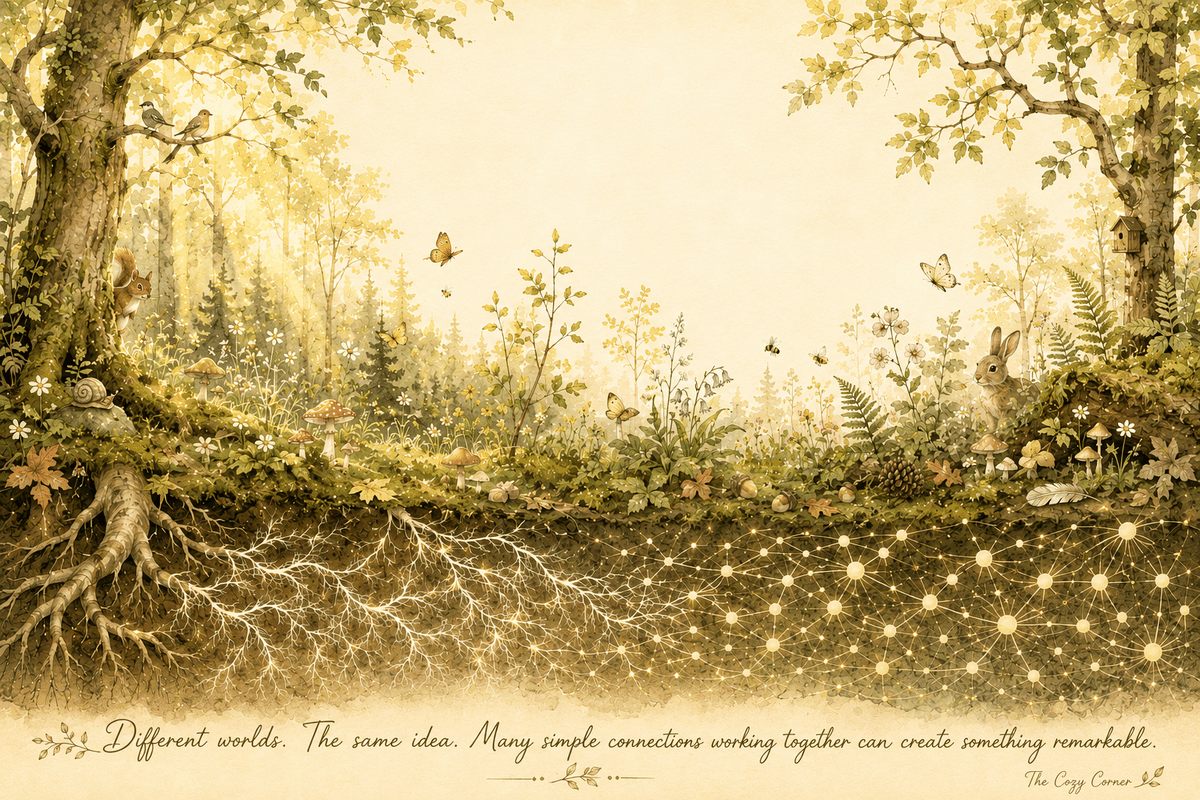
Scientists have discovered that many trees are connected by vast underground networks of fungi called mycorrhizae. These delicate threads weave through the soil, linking the roots of different plants. Through these networks, trees can exchange water, nutrients, and chemical signals. Researchers are still uncovering exactly how these relationships work, and many questions remain. Even so, one thing is becoming increasingly clear: forests are far more connected than they appear.
It’s a gentle reminder that some of nature’s most important work happens where we can’t see it.
🍄 No One Is in Charge
Imagine someone asked you to manage an entire forest. Where would you even begin?
Our instinct is often to look for a leader. Surely there must be a tree calling the shots or directing the others. Yet that’s not how forests work.
Instead, every tree responds to the small part of the world around it. One reacts to changing sunlight, another to dry soil, while another responds to insects nibbling at its leaves. Each tree makes countless tiny adjustments based only on its local environment.
On their own, these decisions seem insignificant. Together, however, they create a living ecosystem that has adapted to storms, droughts, diseases, and changing seasons for thousands of years.
📎 The technical anchor: When many simple parts, each following their own local rules, combine to produce complex, coordinated behaviour that none of them planned individually. That’s called emergence. No single tree “designed” the forest’s resilience. It emerged from thousands of small, local decisions. This exact idea shows up constantly in computer science, and it’s the key to understanding how AI actually works.
🤖 A Similar Idea Lives Inside AI
Surprisingly, this same idea appears in modern artificial intelligence, almost literally.
When people imagine AI, they often picture one incredibly powerful computer making brilliant decisions. In reality, many AI systems work very differently. They are built from neural networks: enormous numbers of tiny artificial neurons, each performing a very small, simple calculation.
A single artificial neuron does almost nothing on its own, really just a small piece of arithmetic. It can’t recognise a face, understand a sentence, or answer a question. But when millions of these simple calculations are layered and connected together, something remarkable emerges. The system can recognise patterns, translate languages, generate images, and even help write stories.
Here’s the connection made concrete: a neural network’s neuron is doing the same kind of thing as a single tree, reacting only to its own small, local input (the signal from the neurons connected to it), with no awareness of the big picture. The “intelligence” isn’t stored in any one neuron, just like the forest’s resilience isn’t stored in any one tree. It lives in the pattern of connections between them (what data scientists call the network’s architecture).
So the next time you hear “neural network,” you can picture a forest: not one genius tree, but millions of ordinary ones, each doing a tiny job, together.
🌱 Nature Has Been Inspiring Great Ideas for Millions of Years
Forests aren’t the only teachers, and this pattern of borrowing from nature has its own name in computing: bio-inspired algorithms.
Scientists and engineers have looked to ants to design routing algorithms (the logic that finds efficient paths, whether for a delivery truck or a data packet crossing a network). They’ve studied bees to build optimisation algorithms, the same category of method used to tune AI models until they perform their best. They’ve observed birds flying in formation to design swarm systems, where many independent agents coordinate without any central leader, a idea now used in everything from drone fleets to distributed computing.
Nature doesn’t hand us instruction manuals. Instead, it offers countless examples of elegant solutions refined over millions of years of evolution. By asking, “How does nature solve this problem?”, researchers often discover genuinely new ways of solving challenges in computing, engineering, and AI.
Sometimes the smartest inventions don’t come from starting with a blank page. Sometimes they begin with paying attention, and then giving the pattern a name so it can be reused.
🌼 Looking at AI a Little Differently
Artificial intelligence can sound intimidating. The name itself feels technical, complicated, and perhaps even a little futuristic.
Yet beneath all the mathematics and programming lies a surprisingly simple idea, one you now have a name for: emergence. Many small parts, each following simple local rules, working together to accomplish something none of them could do alone.
The next time you walk through a forest, remember that you’re surrounded by millions of tiny interactions taking place beneath the surface. No conductor. No manager. No master plan. Just countless connections, each playing a small role in creating something resilient (a forest, or a neural network).
Perhaps that’s why nature continues to inspire the people building AI today. Some of the most powerful ideas in technology weren’t invented from scratch. They were discovered by looking more closely at a world that has been quietly solving problems all along.
🌿 A Cozy Thought
Sometimes the best way to understand technology isn’t by staring at a screen.
Sometimes, it’s by taking a slow walk through the forest, and noticing that the world has been solving complex problems (and has a name for how it does it) long before we ever built a computer.
☕ Keep Wondering…
🐜 How did ants inspire algorithms that find the shortest paths?
🐝 Why are bees surprisingly good at solving complex problems?
🌻 What secret is hidden inside the spirals of a sunflower?
📚 Sources & Further Reading
On mycorrhizal networks:
- Mycorrhizal Networks Facilitate Tree Communication, Learning, and Memory (Simard, S.W., 2018)
- Mycorrhizal network (Wikipedia, accessed 2026)
- “Do Trees Really Support Each Other through a Network of Fungi?” (Scientific American, 2024)
- “Can the wood-wide web really help trees talk to each other?” (BBC Science Focus, 2020)
On bio-inspired algorithms:
- Ant colony optimization algorithms (Wikipedia, accessed 2026)
- “Introduction to Ant Colony Optimization” (GeeksforGeeks)
On bio-inspired computing:
- Bio-inspired computing (Wikipedia, accessed 2026)
- Bio-Inspired Artificial Intelligence: Theories, Methods, and Technologies (MIT Press)